Chapter 12: RSSI Setup
Commonly used receivers include ELRS, TBS_CRSF, and SIYI receivers. SBUS receivers do not provide RSSI.
These receivers use a PWM channel to represent the RSSI signal.
ELRS receivers use CH15 to output the simulated LQ signal quality, TBS CRSF receivers use CH12, and SIYI receivers use CH16.
The RSSI parameters must be configured. Search the full parameter list for RSSI__TYPE.
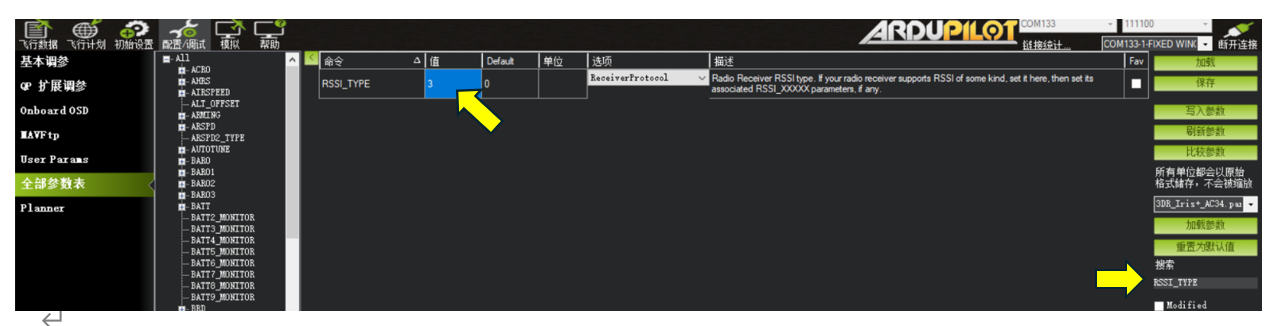
ELRS receivers primarily use LQ to report link quality, so select 3 for this parameter as shown above. For a SIYI receiver, set it to 2. Write the parameters, disconnect the flight controller USB cable, and power off the flight controller.
After reconnecting the flight controller, search for RSSI_CHANNEL.
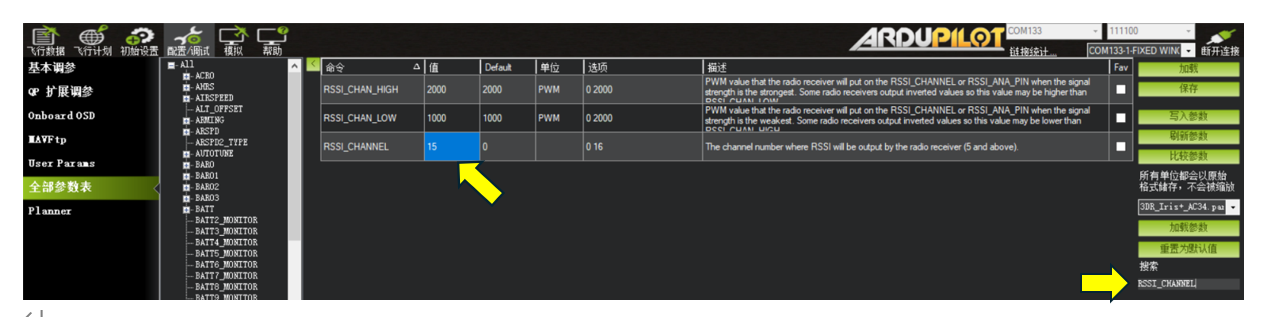
For an ELRS receiver, set RSSI_CHANNEL to 15, then click “Write Parameters.”
For a TBS CRSF receiver, set RSSI_CHANNEL to 12.
For a SIYI receiver, set RSSI_CHANNEL to 16.
During radio transmitter calibration, the radio signal remains at full strength. As a result, both the maximum and minimum values of the applicable channel remain at 2000: channel 15 for ELRS, channel 12 for TBS CRSF, or channel 16 for SIYI. Adjust the maximum and minimum values for that channel to ensure that the RSSI feedback range is correct.
The following example configures the ELRS RSSI channel, channel 15. Search the full parameter list for RC15 as shown below. For a SIYI receiver, search for RC16; for a TBS receiver, search for RC12.
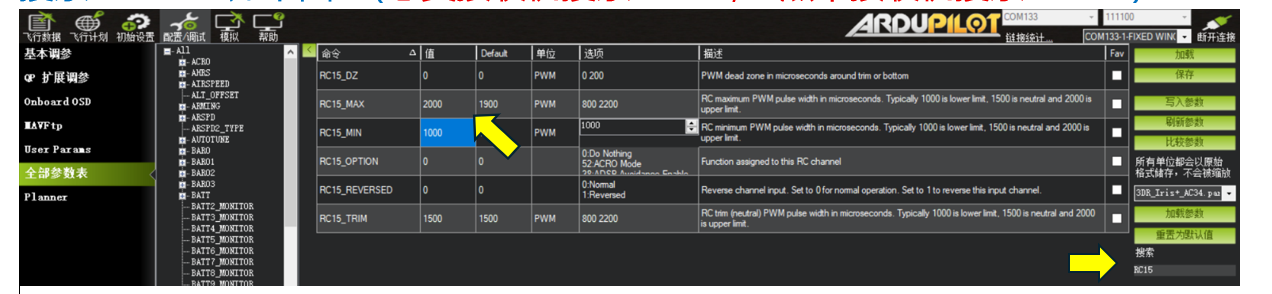
Set RC15_MAX to 2000 and RC15_MIN to 1000.
The RSSI value for the corresponding channel will then display correctly during flight.
In testing with a SIYI FM30 RF module and SIYI receiver, RSSI displays 99 when the radio transmitter is switched on while stationary. If the radio transmitter is switched off while stationary, RSSI remains at 99; there is currently no known workaround.
This does not affect normal operation. During actual range testing and flight, the displayed RSSI value still decreases with distance and signal obstruction. In one test, the aircraft remained indoors while the display, radio transmitter, and FM30 RF module were carried outside, through a closed door, and downstairs; the RSSI value on the display decreased progressively. If the radio transmitter is then switched off, the displayed RSSI drops to 0, failsafe activates automatically, and RTL mode starts.